Drywall repair, Warrensville Heights, OH
Crack and Nail Pop Repair in Warrensville Heights
Crack and nail pop repair in Warrensville Heights is, at bottom, about movement. Framing swells through humid summers and shrinks across a long heating season, and plaster, drywall and the fasteners holding them all respond in ways you can see.
01 Telling cracks apart by their line
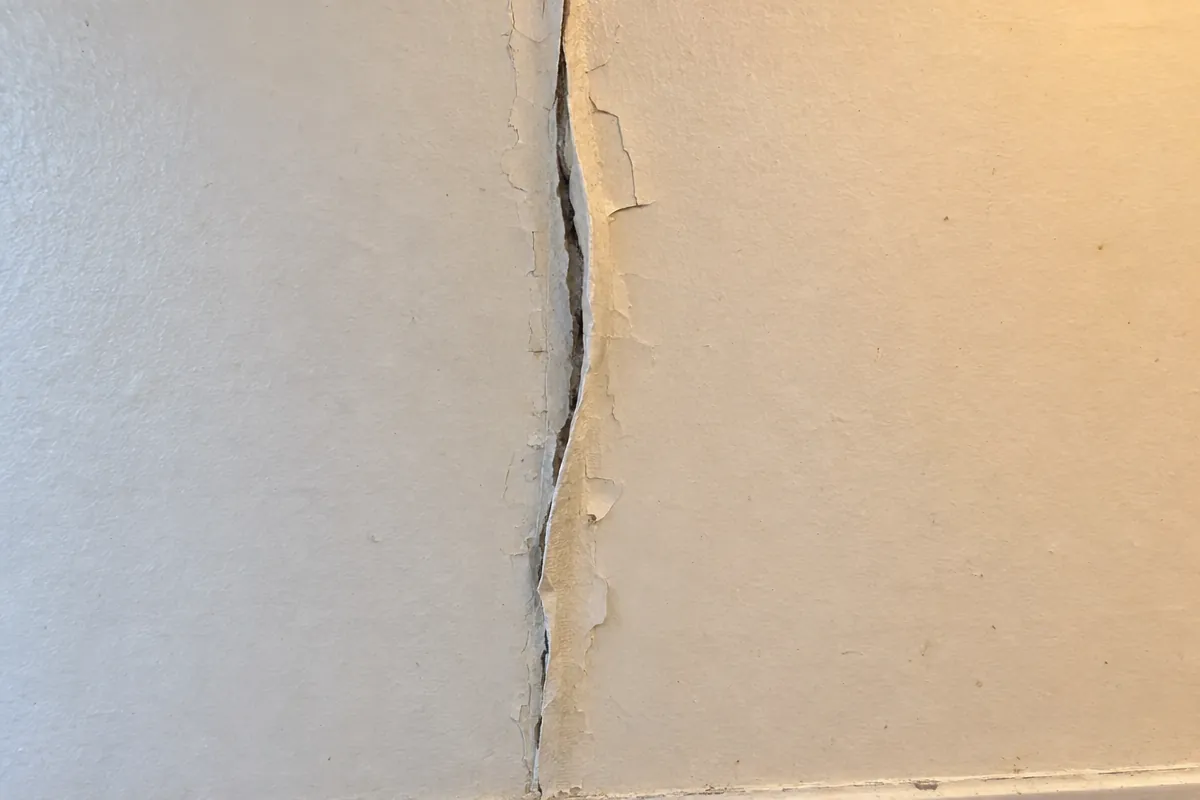
Ruler-straight on a taped joint. The tape between two sheets has let go, often because it was bedded in too thin a layer of mud when the wall was first finished. It runs in a clean line: plumb on walls, straight across on ceilings.
Angled up from a door or window corner. The corners of an opening are where framing movement concentrates. A short line climbing up and away from the corner is common and almost always cosmetic.
At the ceiling line. If the joint between ceiling and partition wall splits apart in the cold months and pulls back together by July, seasonal framing movement is the likely cause, particularly in additions built with trusses.
A spiderweb of fine lines on plaster. Old plaster crazes as it ages and its grip on the lath loosens. That wants a plaster repair, not drywall tape slapped over the surface.
Cracks a coin edge could slide into, stair-stepped cracks, doors that have suddenly begun to bind, or floors that have taken on a slope are a separate matter. Have a structural engineer see those before anyone patches over them.
02 Studs, screws and the board between
Drywall is screwed or nailed to wood studs, standard at 16 inches on center, and the edges of neighboring sheets meet over a stud or are joined across the studs with a taped seam. When a stud dries and slims down after the wall is closed, the timber shrinks back from the fastener. The head stays put and presses a small rounded bump up through the paint: a nail pop.
Homes here go back to the post-war decades, when the old farm village filled in with suburban streets and was declared a city in 1960, and a single house can keep its original walls beside rooms redone much later, so nails and screws both turn up. Older nails pop more often. Newer framing pops through its first couple of winters as it seasons, and January, the coldest month at Cleveland Hopkins, is when furnaces run hardest.
03 Why a crack gets taped, not stuffed
A crack that is only packed with spackle tends to reopen on the very same line, because nothing spans it. A durable crack repair widens the line a touch into a shallow V, clears out anything loose, and beds paper or mesh tape over it. Setting-type compound stands up better in a joint that moves. The tape is buried under two or three thin coats, each reaching past the one beneath it, then sanded level before the texture goes back on.
A nail pop gets a fresh drywall screw driven roughly an inch from the old fastener, drawing the panel tight to the framing. The old nail is sunk below the face or removed, and both spots get mud, a light sanding and touch-up paint. If a whole row has backed out, the whole row is reset, not only the one that caught your eye.
On plaster, the first layer is a bonding liquid, followed by a compound made for plaster. Plaster that has let go of its lath can be pulled back tight with plaster washers before the face is skimmed.
04 National figures for crack work
In Fixr's drywall pricing, updated January 2025, small hairline cracks begin at around $60 and extensive cracking can reach roughly $330. This Old House quotes the same $60 to $330 spread. Both are national guide numbers, not a quote for your wall. The length and height of the cracks, how many cracks or pops there are, plaster or board, and how much texture needs blending all shift the price.
A crack rarely travels alone. If the same room also has holes from shelving or a door handle, see the patching page for rental units; the same punch-list approach works just as well in an owner's house.
05 Cracks and pops: the usual worries
Once a crack is retaped, does it tend to return?
Properly taped and finished, a seam crack is much less inclined to return. A gap driven by seasonal movement at the ceiling line may open slightly again; a flexible corner treatment is the usual answer there.
What separates a cosmetic crack from a structural one?
Width, shape and company. Hairlines at seams and door corners are common. Wide gaps, stair-step patterns in masonry, doors that bind or floors that slope call for a structural engineer first.
Is it worth booking a repair for one or two nail pops?
They are often bundled with other small repairs so one trip covers several rooms. A pop sitting near a seam can also start a crack, so it is better dealt with before the wall is repainted.
06 Photograph the crack in raking light
A picture with a lamp held off to one side, plus a note on how long the line has been there, tells the pro the most.
After you ring, a drywall hand based close by walks through the repair with you and puts a figure on it before any date is set.